

I watched a lime-green cicada lose a fight with my front bumper once, and it left a chip that cost me $340 to have resprayed and blended. That was a small bug. Imagine what a winter’s worth of Kalamazoo-adjacent gravel does to a lower fascia it hits at speed. If you live anywhere in West Michigan and own a car with a factory-clean front end, you’re already losing this fight. Paint protection film is the cheapest way I know to stop paying for it twice.
Here’s what you’ll get in the next few minutes: how the film actually works, why this region is unusually rough on paint, a walkthrough of the coverage options worth considering, and a simple question list to use when you call a shop. One thing I’ll say upfront, because it saves you from reading the whole piece looking for a gotcha: the reason to do it is not resale. It’s that repainting is a headache you can skip entirely.
What Paint Protection Film Actually Does
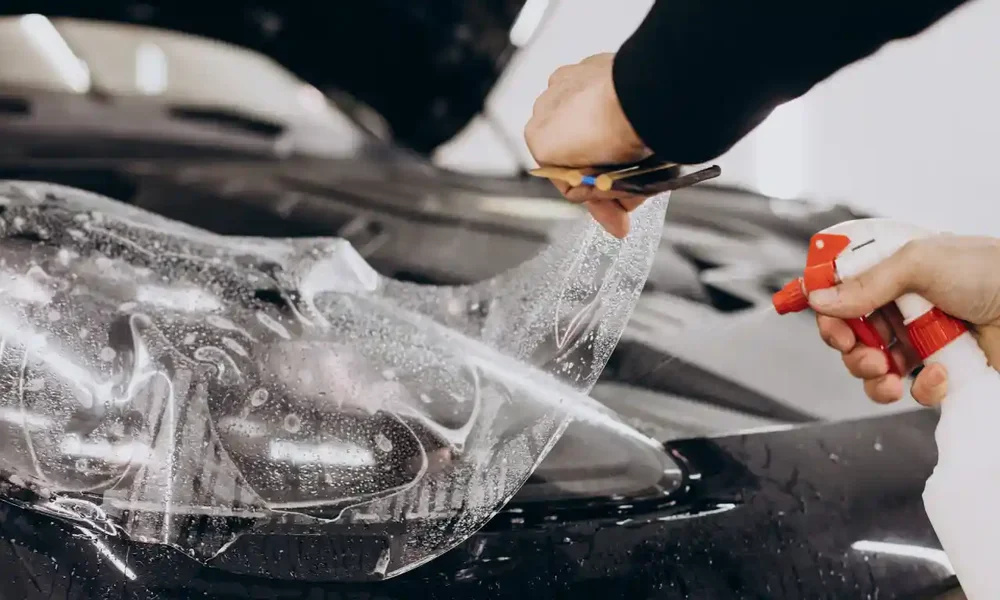
PPF is a clear, flexible urethane layer that goes over your existing paint. It’s not a wax, not a coating, not a wrap. It’s a physical skin, usually somewhere between six and eight mils thick, that gets the dents instead of your car. Think of it as a heavy-duty screen protector, but the phone glass underneath is your paint job and you can’t replace it.
The film does a few separate jobs, and it’s worth knowing which matters to you:
- Impact absorption. Small rocks, gravel, and bugs bounce off instead of taking a divot out of the clear coat.
- UV blocking. Sun exposure fades and dulls pigment. Paint here spends its whole life outside.
- Self-healing. Light surface scuffs flatten back out with sun and warmth, which West Michigan gets plenty of in July.
- Chemical resistance. Salt slurry and road brine sit on panels for months.
My honest opinion is that self-healing is the most oversold feature. What you’re really buying is the impact protection, because a self-healed spot still looks like a spot if something gouged it first.
West Michigan Is Genuinely Hard on Paint
This isn’t shop talk. Michigan roads have enough non-paved surface miles to spread loose material across the driving line for most of the year, and our snowbelt gets lake-effect snow that districts respond to with salt, sand, and brine. According to the Bureau of Labor Statistics, construction and heavy road work employ a large share of workers in this region, and that traffic keeps a steady supply of debris on the ground you drive over every day.
Then layer in winter. According to the National Oceanic and Atmospheric Administration, the Great Lakes region’s lake-effect snow zones regularly see extreme seasonal snowfall totals. Snow gets plowed, sand goes down, and every one of those granules is a tiny abrasive your fender catches at 45 miles per hour in February.
What’s the rest of the equation? Front ends take the worst of it. Based on what I’ve seen on a two-year-old daily driver here, your bumper, hood leading edge, headlight surrounds, mirror caps, and door cups will look five years older than the rest of the car. Rear cargo areas take it too if you’re loading bikes or coolers in and out all summer.
Front End, Door Cups, or Full Vehicle?
Coverage is the only real decision, and there’s no single right answer. Here’s how I’d break it down for someone in Kalamazoo or a nearby town like Portage, Mattawan, or Plainwell.
| Package | What Gets Covered | Who It Suits |
|---|---|---|
| Front end | Bumper, partial or full hood, fenders, mirrors, headlights | Lease drivers, commuters, anyone who hates chips but wants a modest spend |
| Door cups, mirrors, rockers | The zones fingernails, curbs, and flung gravel hit hardest | Anyone with a paint color that shows every mark, which is most dark and white finishes |
| Rear cargo scruff | Rear bumper and load area edges | Cyclists, hunters, dog owners, anyone loading gear solo |
| Full vehicle | Every factory-painted panel | New car or truck you plan to keep a decade, or a vehicle with a hard-to-match finish |
If it were my money on a three-year-old SUV I planned to drive into the ground, I’d do full hood, bumper, mirror caps, door cups, and the rear load edge. That covers roughly the areas that actually get hit, and it keeps the cost well under a full vehicle kit. If it’s a leased car or something you expect to trade in soon, front end plus door cups is enough.
How to Pick a Shop and What to Ask
Film quality matters less than the person cutting and applying it. A premium film installed badly will lift, trap dust, and show stretch marks. Run through this before you commit:
- Ask for full coverage photos and panel count in writing, so you know what’s film and what’s edge.
- Confirm the film brand and the warranty length, and whether it’s registered in your name.
- Check whether panels are wrapped with tucked edges or left with visible seams.
- Ask about plotter-cut patterns versus bulk-cut, since pre-cut patterns give cleaner reveals on complex bumpers.
- Find out how long the shop wants the car. Rushed installation is where trapped moisture and dust show up.
- Ask what happens if a panel lifts six months in. Good shops handle it without an argument.
When you compare quotes, ask about prep. Washing, decontaminating, and removing existing chips first is what separates a finish that lasts from one that peels around old damage. On that note, PPF installation in Kalamazoo, MI from a shop that plots patterns for your exact make and model keeps coverage tight around emblems, sensors, and grille slats.
According to the National Highway Traffic Safety Administration, vehicle safety systems and sensor suites now sit across the front fascia on most new vehicles, so you want a shop that knows where they are before blades and squeegees come out.
Pairing It With Ceramic Coating
Film and ceramic coating do different jobs, and they stack well. The film takes physical hits. A ceramic coating on top adds slickness, so bugs, sap, and salt spray wipe off with a hose instead of a scrub pad. If you go this route, do the coating after the film has fully cured. Ask your installer what their preferred cure window is, because it varies by film and by humidity.
What It Costs You Long Term
Rough math, and it’s rough: a resprayed bumper and blended hood runs into four figures at a decent body shop, and you might need it twice over ten years in this climate. Front-end film runs a fraction of one repair, which is the whole argument in a sentence. Insurance often won’t cover paint-only damage either, so that bill lands in your lap.
The case for film is boring and practical. It’s cheaper than repainting, it keeps your car looking like it did the day you bought it, and it takes one afternoon to arrange. Call your local shop, get a written quote with panel coverage spelled out, and ask them to walk you to the rack and show you what full coverage actually looks like on a finished vehicle. Your bumper will thank you the first time a salt truck cuts you off.
