

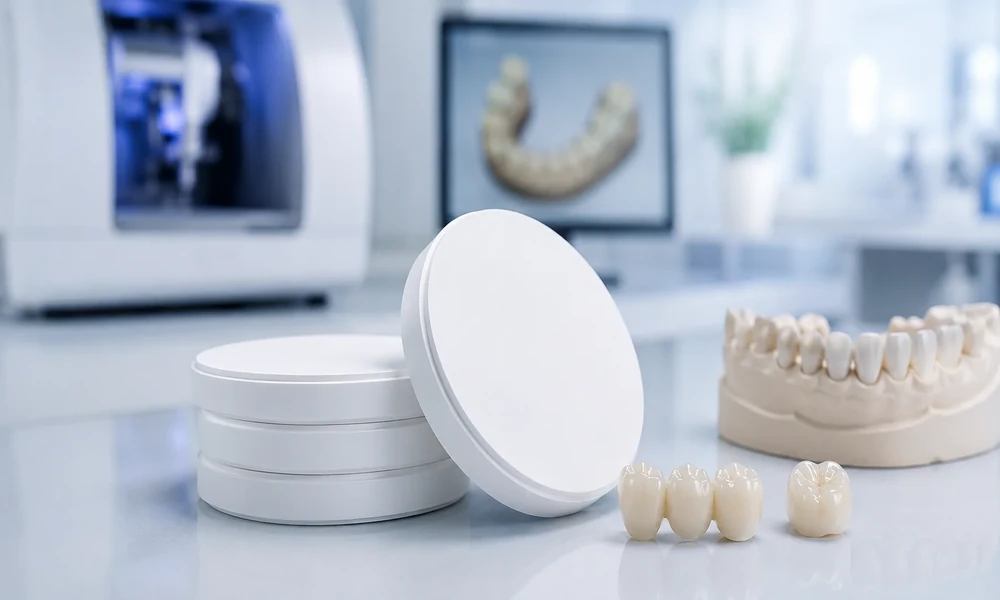
Choosing a zirconia is less about finding the “best” disc and more about finding the one that suits the cases coming through your door. TT One pre-shaded zirconia comes from Upcera, a Chinese dental ceramics manufacturer (Liaoning Upcera Co., Ltd. is the company named on its FDA zirconia filing), and it is one of several TT One variants sold to labs that mill their own restorations. Trade listings describe the TT One family in three forms: a multilayer version, a pre-shaded version and a white version. The pre-shaded discs are described as a monoblock zirconia, meaning a single uniform shade through the whole blank, with natural-looking esthetics and high strength. Depending on the mill, labs order the same material as TT One pre-shaded dental blocks or as larger discs, and the choice between them shapes how the product fits into daily production.
That description is a useful starting point, but it does not answer the practical question every lab owner asks: will this material save time and hold up on my cases? The honest answer depends on workload, case mix, equipment and documentation, so each of those deserves a closer look.
What Is the Difference Between TT One Pre-Shaded Zirconia Discs and White Zirconia?
White zirconia leaves the shade decision for later. After milling, the technician colors the restoration with immersion liquids or brush-on shading before sintering, and then adjusts with stains and glaze. That approach gives a lot of control but depends heavily on individual skill and timing.
TT One pre-shaded zirconia discs arrive with the color already in the material. Once the restoration is milled, it can go straight into the sintering furnace, and only surface characterization remains. For a lab producing a steady stream of crowns, that removes a manual step that is easy to get slightly wrong, especially when several technicians share the work. The white version still has a place for cases needing custom internal coloring, so some labs keep both.
How Do TT One Pre-Shaded Dental Blocks Fit Different Milling Systems?
Zirconia is sold in two broad formats. Discs, usually 98 mm in diameter, fit the open mills found in most production labs. Blocks are smaller and fit chairside or compact milling units that take a mandrel-mounted blank. TT One pre-shaded dental blocks and discs are sold in more than one thickness, so the first check is simply whether the format matches your mill’s holder.
Thickness affects both cost per unit and nesting flexibility. A thin disc suits copings and posterior crowns, while a taller blank is needed for long bridges or implant superstructures with deep connectors. Work out the height of your typical restorations, add the allowance your CAM software needs, and select from there. Ordering one thickness for everything often wastes material.
When Should a Lab Choose TT One Multilayer Dental Blocks Instead?
TT One multilayer dental blocks and discs are built with a gradient, so chroma and translucency change from the cervical area to the incisal edge. That makes the multilayer version attractive for anterior crowns and visible premolars, where a flat single shade can look lifeless.
The pre-shaded monoblock version tends to suit:
- Posterior single crowns where strength and an even shade matter more than incisal effects
- Bridges where a consistent body color across several units is the goal
- Screw-retained implant crowns that receive final characterization with stains
- High-volume production where predictability is worth more than gradient effects
Mixed case loads often justify stocking both. The decision is less about which product is better and more about matching the material to the tooth position.
Is TT One Pre-Shaded Zirconia FDA Cleared for Use in the United States?
Upcera’s dental zirconia blank and dental zirconia pre-shaded blank received FDA 510(k) clearance in 2014 under the product code for porcelain powder for clinical use, a Class II device category. The cleared indications describe blanks used for dental restorations made on CAD/CAM or manual milling machines by dental laboratories or dental professionals. Upcera pre-shaded blanks also appear in the FDA’s Global Unique Device Identification Database.
That clearance covers Upcera’s zirconia blanks under their 2014 device name; it does not by itself confirm that a particular TT One label or lot falls under it. Labs should check that the packaging carries a device identifier and that the instructions for use list the indications you plan to work within. Keep a copy of the labeling with your case records, since a dentist or inspector may ask which material went into a restoration. Good records also make it far easier to trace a problem back to a single lot if a batch ever behaves differently in the furnace.
What Should You Check Before You Buy TT One Pre-Shaded Zirconia Online?
Labs that buy TT One pre-shaded zirconia online should look closely at what comes with the disc, not just the disc itself. Every blank should carry a lot number and an enlargement factor, which your CAM software needs to compensate for sintering shrinkage. Missing or unreadable labels make accurate fit difficult and traceability impossible.
Ask whether the seller supplies the manufacturer’s instructions for use and the recommended sintering program. Confirm the shade system used (most pre-shaded zirconia follows the familiar A to D shade guide) and whether bleach shades are available. Storage and shipping matter as well: pre-sintered zirconia is fragile and should arrive in protective packaging without chips at the rim. Finally, compare lot-to-lot consistency by milling a test crown from each new batch before it goes into patient work.
Should a Lab Trial a New Pre-Shaded Zirconia Before Switching?
A short, structured trial gives you real answers. Mill the same three or four restorations from your current material and from the TT One disc, sinter each on its manufacturer’s program, and compare marginal fit, shade against a physical shade tab, and translucency on a light box. Track remakes and bench time for a few weeks, and let those numbers, rather than first impressions, decide whether the material earns a permanent place on the shelf.
